
Decode Meriwether County Property Tax Records
Start with one comparison. The Tax Assessor keeps the value side of Meriwether County property tax records, and the Tax Commissioner keeps the billing side. Both offices sit in Greenville. Their authority is different, so know which one you need.
| Field | What It Shows | Where |
|---|---|---|
| Appraised value | Assessor estimate for the digest year | Tax Assessor / qPublic |
| Assessed and taxable value | Tax figures after the statutory ratio and relief | Tax Assessor / qPublic |
| Exemptions | Approved homestead or specialized classification | Tax Assessor |
| Bill and status | Charges, credits, balance, and delinquency | Tax Commissioner |
| Tax district | County, city, school, or other bill components | Tax Commissioner |
The assessor's qPublic data serves tax purposes only. It is not legally binding, and it reflects the most recent published digest. A bill simply applies rates and exemptions to taxable value. It proves neither sale price nor title.
Send Meriwether Tax Questions to the Right Office
For value questions, contact the Tax Assessor. The office handles fair-market-value appraisal, uniformity, exemptions, returns, and appeals. It lists PO Box 187 in Greenville, phone 706-672-4222, email taxassessor@meriwethercountyga.gov, and weekday hours of 8:30 a.m. to 5:00 p.m. Staff may visit during a return, appeal, permit, exemption, or conservation-use application, or a routine review. Official staff carry identification and drive marked vehicles.
The Tax Commissioner handles everything on the money side: billing, collection, delinquency, and tax sales. That office sits at 17234 Roosevelt Highway, Building A, Greenville, reachable at 706-672-4219, open weekdays 8:30 a.m. to 4:30 p.m. Value disputes go to the assessor. Payment and balance questions go to the Commissioner.
Check Meriwether Exemptions Before Comparing Bills
The assessor's exemption guidance sets the rules for the standard homestead. It applies to a legal residence owned and occupied on January 1. Filing runs January 1 through April 1. It generally renews automatically unless ownership or eligibility changes. Published standard relief is $2,000 against the 40 percent assessed value.
The same page covers senior and school-tax relief. It also lists disabled-veteran and surviving-spouse provisions, conservation use, agricultural classifications, and Freeport. Eligibility rules differ by program. Keep your filing confirmation safe.
The official exemption and appeal screen is pictured below.
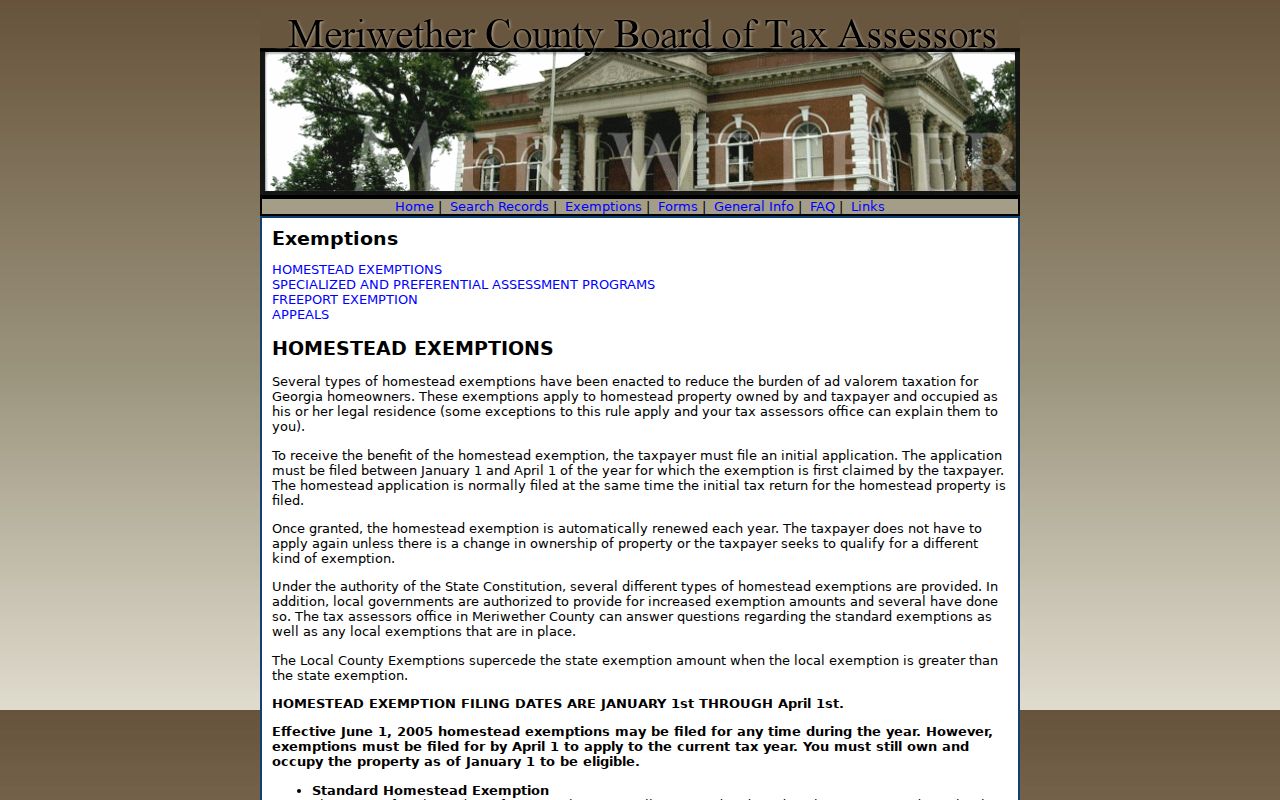
Program dates and rules can shift from year to year. Check the current notice instead of inferring anything from an older bill.
Look Up a Meriwether County Tax Bill
The Commissioner links Government Window for online property-tax search and payment. The tax screen's specific controls are not described here, so explore the start page directly when you need a bill lookup.
- Open the Government Window start page and select property tax.
- Pass the CAPTCHA manually and match the exact map/parcel and tax year.
- Compare value and exemptions with the assessor parcel.
- Ask the Commissioner to confirm balances, credits, delinquency, sale, or redemption status.
- Assessed value
- The statutory assessment portion derived from fair-market value.
- Mill rate or levy
- The locally set rate used to calculate tax.
- Homestead exemption
- Qualified relief for an owner-occupied legal residence.
- Tax lien
- A claim arising from unpaid tax that needs current verification.
The official payment-selection screen appears below.
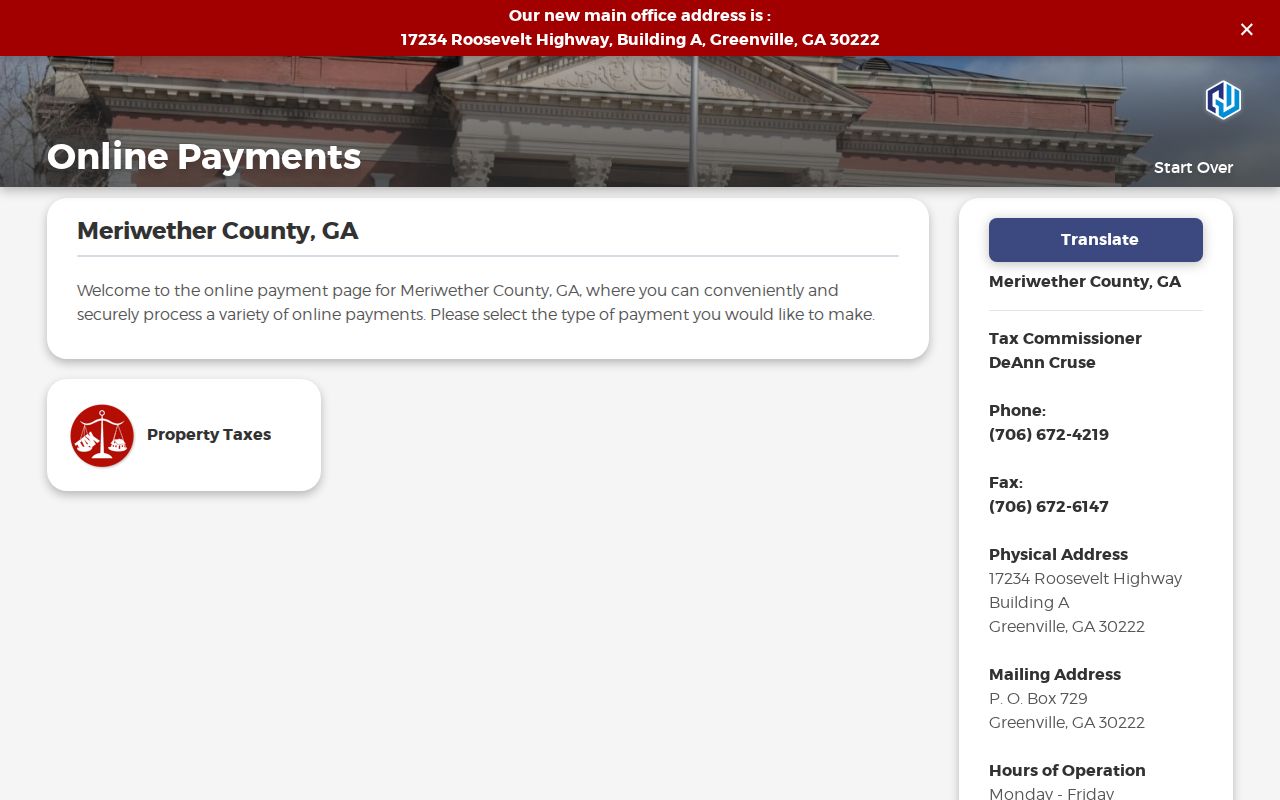
It confirms the county route and contact details without overstating the inaccessible bill fields.
Separate City and County Tax Components
The Tax Commissioner's FAQ clarifies who pays whom. Residents of Luthersville, Manchester, Warm Springs, Woodbury, Greenville, and Lone Oak pay city taxes. They also pay county taxes through the county Commissioner. A postal city name settles nothing about municipal limits. Compare the tax district against the mapped parcel. Ask the office to identify each component of your bill.
Value and exemption questions go back to the assessor. Rate, billed amount, collection status, and payment allocation belong to the Commissioner. A city utility account is not a tax-parcel or ownership record.
Treat Meriwether Tax-Sale Lists as Dated Leads
The Commissioner posts current notices along with a Tax Sale tab. One notice dated September 1, 2026 listed registration at 8:30 a.m. and the sale at 10:00 a.m. Payment, withdrawal, sale, and redemption can change a property's status fast. A 2025 official list included map and parcel number, owner, amount, tax years, deed-book references, and legal-description excerpts.
Save the dated list as a lead. Then check the current bill, the assessor parcel card, recorded deeds and liens, and any related court files. Keep the advertised amount separate from the bid, the redemption amount, accumulated costs, and later title expense.
The official Tax Commissioner page is pictured below.
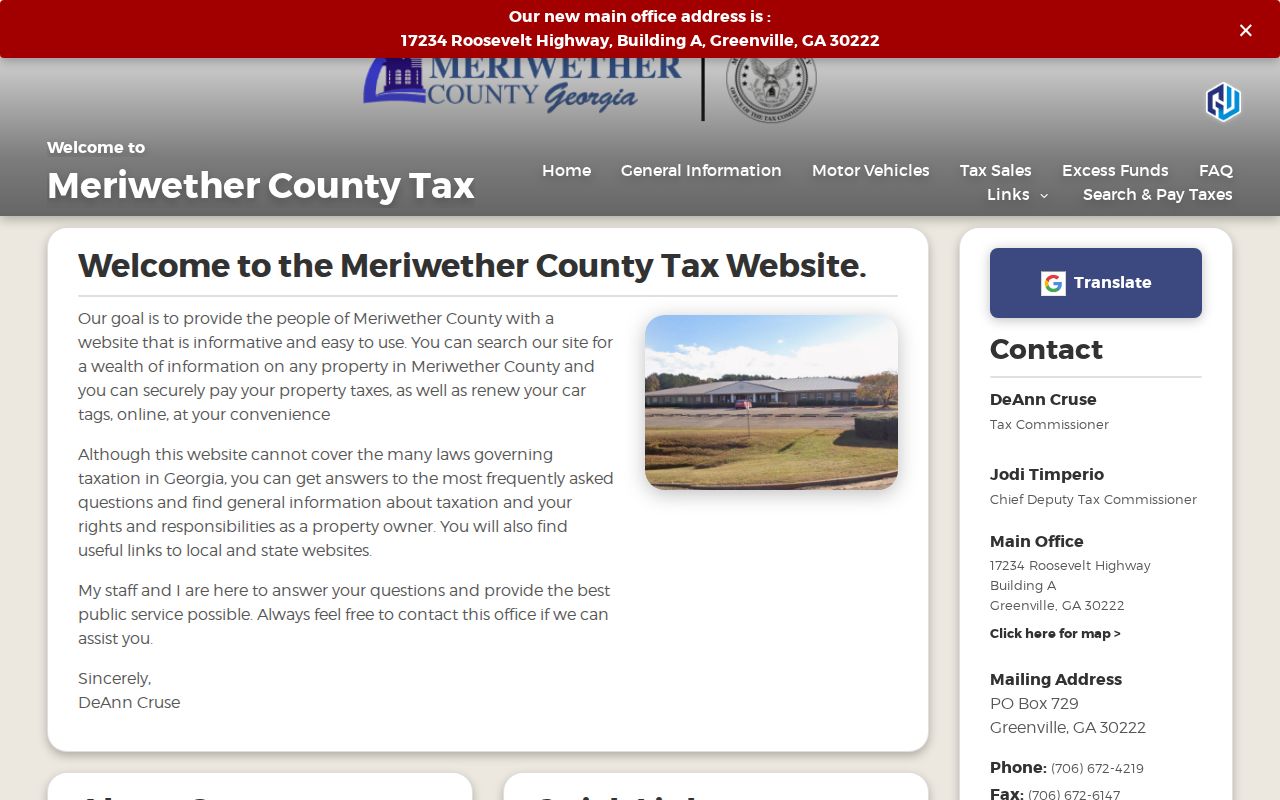
The date shown on any notice should be saved and rechecked directly before reliance.
Appeal a Meriwether County Assessment on Time
An appeal of a notice of change must reach the Board of Tax Assessors within 45 days. Accepted grounds are taxability, value, or uniformity. Simple dislike of the amount levied is not a ground. Compare the notice against the parcel card, deed references, photographs, permits, comparable sales evidence, and any factual corrections.
If the Board leaves the value unchanged, the appeal moves to the County Board of Equalization. Further review may go to Superior Court. Arbitration is available under stated conditions. Filing an open-records request will not pause the statutory deadline.
Appeal window. File within 45 days of the notice with the Meriwether County Board of Tax Assessors, using the deadline printed on that notice.
Request Missing Meriwether Tax Records
Contact the Commissioner with the exact map and parcel. Include the address and the tax years. State the status you need. Ask for existing bills, payments or credits, delinquency, sale-list and withdrawal status, and redemption information. Request prior property cards or digest entries from the assessor as well.
The Georgia Open Records Act, OCGA 50-18-70 et seq., sets the clock. A response generally comes within three business days. Otherwise you receive a timetable, a cost estimate, and the legal basis for anything withheld. Copy and search charges may apply. The first 15 minutes of staff search time are excluded. Ask for existing records rather than a custom tax history.
A strong assessor request names the address and map/parcel. It seeks the current and prior published property cards or digest entries. It also covers the tax year, owner label, situs, appraised, assessed, and taxable values, exemptions, sale or deed references, and any existing sketch. A strong collector request uses that same key. It asks for the precise tax years due, credits, payment dates, and delinquency. It also asks for current sale or redemption status. Stating a preferred electronic format and accepting a cost estimate keeps each request narrow.
Paid receipts and tax reports can carry retention periods. These can differ from permanent real-property record cards. When a year disappears online, ask which office holds custody. Ask whether the answer comes from an active system, a retained report, a paper file, or an archive. Label that source in your finished tax packet. That way a historic receipt cannot masquerade as current status.
Reconcile the Meriwether Tax Year and Parcel Key
A good worksheet gives every source its own row. Record the office, tax year, access date, exact map and parcel, owner label, situs, appraised value, assessed value, taxable value, exemptions, tax district, bill amount, payments, balance, and any conflict. Never merge values across digest years or treat a tax-sale notice as current.
Assessor records sometimes display a deed or sale reference. That reference is a lead, not proof. Open the recorded instrument through GSCCCA or the Clerk and compare the legal description. A mailing address shows where mail goes. It is not proof of residence, possession, or municipal location. The situs can also differ from a route history or postal-city label.
If ownership changed recently, the deed index and published digest may update on different schedules, so preserve each displayed date. Ask the assessor which digest is online. A January 2026 county agenda discussed updated subscription pricing for a digital property-information platform. It showed no finalized purchase and no system replacement. Use the currently linked official sources.
Verify Meriwether Delinquency Beyond an Old List
A sale-list appearance is a flag, not a verdict. Ask whether the parcel was paid, withdrawn, sold, carried forward, or redeemed. Preserve the advertised tax years and map/parcel. Then locate any recorded tax deed, redemption, later conveyance, lien release, or quiet-title case. The Clerk's land and General Execution indexes answer questions a bill screen cannot. So do Superior Court civil files.
Georgia law and local procedures can change, so confirm legal consequences from the current official notice and governing statute. The Tax Commissioner's office verifies collection status. An attorney evaluates redemption and title consequences. Never treat an assessed value, a low advertised amount, or a tax-sale entry as a market estimate or a buying recommendation.
For annual comparison, set each digest year beside its matching bill rather than comparing unmatched screens. Note changes in appraised value, assessed value, exemptions, district, levy, credits, and payment status. A change may reflect appraisal review, exemption eligibility, parcel division, or municipal status. It may also mean a corrected record. Ask the office for the underlying notice or entry. Guessing the cause invites error. This discipline makes Meriwether County property tax records useful for an appeal or closing review. It still respects the line between tax administration, recorded ownership, and independent valuation.
Keep a log of every confirmation. Record the access date, staff office, parcel key, tax year, and stated status. Save each answer with the date. That small record separates a live collection answer from an older portal view.