
Trace Back Meriwether Former Owners
Work backward from the newest recorded deed, one conveyance at a time, until the chain of past owners runs out or reaches the original land grant. The GSCCCA Real Estate index covers Meriwether deed records from January 1, 1980 forward, which handles most modern transfers online. Earlier owners take more effort. Courthouse deed books and Georgia Archives microfilm carry the older instrument books. Plats and tax digests help when a parcel's identity shifted over the decades. Neither one substitutes for the recorded deed itself.
| Source | Years It Covers | Where Held | What It Shows |
|---|---|---|---|
| GSCCCA deed index | 1980 to checked good-through date | Statewide online system | Grantor, grantee, instrument, book/page |
| Deed books | Earlier local series | Superior Court Clerk | Recorded conveyances and descriptions |
| County microfilm | Series-dependent | Georgia Archives | Older deed, tax, estate, and court leads |
| Historic plats | Series-dependent | Clerk and archives | Lot, subdivision, and survey context |
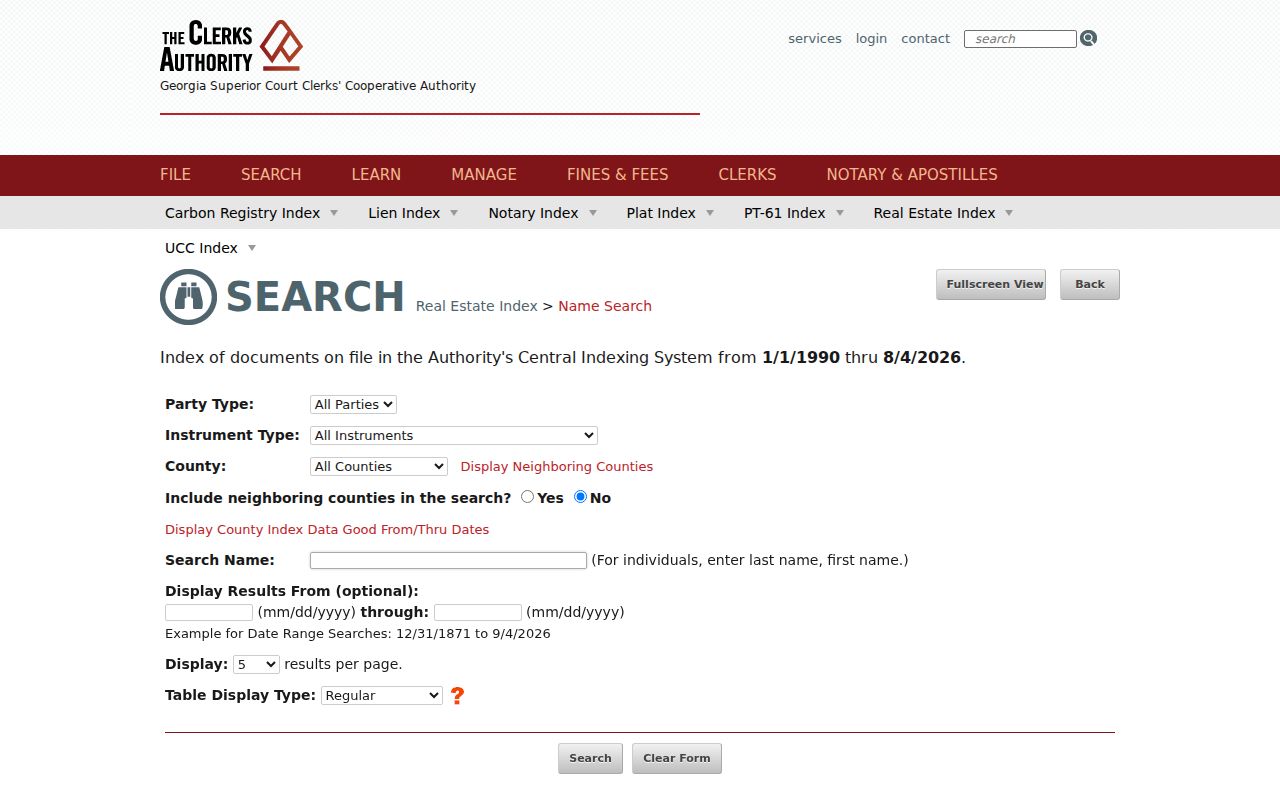
A twentieth-century transfer often starts online. A nineteenth-century chain means asking the Clerk for the right deed-book series. It also means checking the Archives' county microfilm index. Carry every citation forward: book and page, land lot, district, acreage, and plat references. The backward search itself begins at the GSCCCA real-estate name search.
Build a Meriwether Deed Timeline
Build the timeline one row per transfer. Record the date, grantor, grantee, deed type, and book/page citation for each. Add the legal description. Include any prior deed the instrument cites. A warranty deed, quitclaim, executor's deed, and security deed each do different legal work. Label every instrument exactly as recorded.
| Transfer Date | Grantor to Grantee | Deed Type | Book/Page |
|---|---|---|---|
| Newest recording | Prior owner to current grantee | As indexed | Copy exactly |
| Earlier recording | Earlier owner to prior owner | As indexed | Follow cited deed |
| Legacy book entry | Historic parties | As written | Clerk or microfilm |
This format exposes gaps, overlapping claims, and name changes instead of hiding them.
Match Old Meriwether Land Identity
One rural tract can carry several identities at once. These include postal address, assessor situs, parcel number, land lot and district, subdivision lot, and plat citation. Older deeds lean on land-lot descriptions or metes and bounds. Preserve the bearings, distances, creeks, roads, easements, exceptions, and any fractional interest in your notes. Meriwether tax-sale parcels appear in varied formats, such as MA06 052 and GR06 078 B02. Assume no fixed structure. Addresses change and parcels split without any transfer of title. The legal description remains the strongest bridge between eras of ownership.
Reconstruct Meriwether's Chain Backward
Search the current owner as grantee first. That finds the acquisition deed. Read its grantor, then search that name as grantee in an earlier period, repeating the loop while confirming the legal description matches the same tract every time. A shared surname is only a lead, never proof of a transfer.
- Find the present owner's acquisition deed.
- Read the grantor and cited prior deed.
- Search that grantor as an earlier grantee.
- Match the land description, not just the name.
- At the online cutoff, continue in deed books or microfilm.
- Grantor / grantee
- The conveying party and receiving party.
- Chain of title
- The ordered sequence of recorded interests.
- Reverse index
- An index arranged to help follow parties backward.
- Legal description
- The land wording that survives address change.
Meriwether Courthouse Clues and Gaps
Meriwether County formed in 1827, and its first officers took office in 1828. Greenville's courthouse-centered town plan dates to that same year. Later disruptions included an 1893 tornado and a 1903 courthouse replacement. A 1976 fire came next, followed by restoration. None of that means old records vanished. It just means the search should move series by series. Don't assume a single shelf holds everything. The Georgia Archives county microfilm cards list holdings and flag courthouse disasters. Archives guidance also notes that boundary changes can affect deeds. A deed may sit in a neighboring or predecessor county. When a chain stops abruptly, search both the historic jurisdiction and the current custodian.
Place Past Meriwether Owners on Maps
The 1926 Greenville Sanborn map preserves blocks, building footprints, materials, uses, and fire-protection details. It can turn an old downtown address into a modern parcel candidate. It cannot prove ownership. Match its block and house numbers against the deed, the plat, and the present GIS parcel layer. Only then draw conclusions. Historic plats often reveal a subdivision lot or an earlier survey. A deed sometimes says land is more particularly shown on a plat. That cited plat is part of the chain itself. A licensed surveyor still handles any present boundary question that matters. Greenville's 1828 plan laid out a courthouse-centered grid of 20 blocks. Civic and community spaces were reserved within it. That geometry helps decode an early square or block reference. Outside town, roads, creeks, fractional land lots, and district numbers usually link eras better. A historic map narrows the candidate tract. The deed sequence still has to tie each former owner to the same land.
Request Older Meriwether Deeds
The Clerk of Superior Court Real Estate Division sits at 100 North Court Square, PO Box 160, Greenville, GA 30222, telephone 706-672-4416. A written request works best when it includes party names, an approximate date, deed type, book/page or instrument number, address, parcel ID, and whether you want an image or a certified copy. The more detail, the faster the pull. The county notes that not all records are online because of storage and funding limits. The Archives holds many early deed, estate, tax, and court series on microfilm, while later records stay local. A gap online is a cue to try the counter, a written request, or the Archives. It is not proof that past owners cannot be traced.
Follow Meriwether Estate Transfers
An estate label can break a tidy owner chain. Search the decedent, the executor, the administrator, and the estate name. Then search the later grantee separately too. Read the deed to see in what capacity a signer acted. Then consult Probate Court records for the proceeding that authorized the conveyance. An estate name on a tax list is a lead, nothing more. Security deeds, releases, liens, easements, and quiet-title cases can each affect an interest. That interest can change without any simple sale between owners. Keep those instrument types distinct in your timeline. The Superior Court civil file may add context to a lien or quiet-title dispute. Georgia Courts eAccess may add context as well. Before any court result enters the ownership record, match it to the same legal description.
Audit the Meriwether Owner Chain
Audit the Meriwether County deed chain with care. It covers written and recorded dates. It also covers grantor and grantee capacity, consideration, and the legal description itself. Check the land lot, district, lot, block, subdivision, acreage, bearings, roads, easements, and reservations. Check any plats a deed cites, too. Copy the less-and-except and subject-to clauses word for word. Those phrases matter. They can show a partial conveyance of an earlier tract. Or they can reveal an interest the grantor kept.
Explain any mismatches you meet along the way. Owner names, acreage, city, value, and dates can all disagree between the deed records and the tax roll. Treat draft, outdated, or third-party material with care. Note when an index cannot be reached. The finished timeline should label each point plainly. Label it a recorded instrument fact, a tax-record clue, a historical map lead, or an unresolved legal question.
How Far Meriwether Ownership Goes
Meriwether County property records online reach back only as far as the displayed index start. Earlier owners surface in surviving deed books, plats, tax digests, probate papers, and microfilm. Records from changes in county identity also help. A gap is not always a missing deed. It may reflect lost indexing, a different surname, or an estate holding. It may also be an unrecorded interest or an instrument filed in another county entirely. Statewide digitization helps. But it is an access layer, not a substitute for every original volume.
House history works best when each conclusion carries its source and date. A tax name is not a deed. A map is not a survey. A deed sequence is not a legal title opinion. The chain may turn complicated. The Clerk, Archives staff, or a Georgia title professional can then help close the gap in the property records.
Lawful use. Trace past owners for house history and property diligence. Never use the record to track, harass, intimidate, or harm a living person.