
What Meriwether County Deed Records Convey
The Clerk of Superior Court's Real Estate Division is where Meriwether County records land transactions, plats, and related liens. Every deed speaks as of its recording date. It names the parties, shows the execution and recording stamp, notes any consideration or transfer-tax entry, and lays out the legal description. The instrument's type and language control.
| Deed Type | What It Does | Common Use |
|---|---|---|
| Warranty deed | Conveys the described interest with stated title covenants | Ordinary arm's-length transfers |
| Quitclaim deed | Transfers whatever interest the grantor holds without broad warranties | Family transfers or curing a possible interest |
| Security deed | Secures a debt against real property | Loan and release research, not a sale by itself |
| Executor or administrator deed | Conveys under documented estate authority | Probate-related transfers |
| Tax deed | Records a conveyance arising from a tax sale | Delinquency and redemption research |
Not every recorded instrument conveys land. A security deed, lien, assignment, cancellation, or lis pendens may sit beside a deed, and each answers a different question about the parcel, so read the instrument type and any later release before assuming it still binds. The index row alone proves little.
The Real Estate Division Holds Meriwether Land Records
The Clerk's Real Estate Division holds Meriwether County's land records. It is separate from the County Clerk, who handles general open-records requests for the county. The office sits at 100 North Court Square, PO Box 160, Greenville, GA 30222, and the telephone number is 706-672-4416. Plats are recorded here as well. Staff describe land indexes searchable by year and name.
Bring details when you call, write, or visit. Grantor and grantee names, an approximate recording date, a deed book and page or instrument number if known, the property address, the map and parcel, and the document type all help the search. An address alone may not pull an older deed. Ask about terminal access, off-line books, image availability, and copying or certification charges, because the statewide screen is not the whole story.
Note: The County Clerk's open-records channel does not replace the Superior Court Clerk as custodian of recorded land instruments.
Use Meriwether's GSCCCA Search Fields Deliberately
The GSCCCA name search has real power. Its filters can make a Meriwether County deed search reproducible, so start broad, save the result set, and narrow only after learning the local instrument labels.
| Index control | Entry | What to inspect |
|---|---|---|
| Party type | Grantor or grantee | Repeat the legal name in both roles |
| Instrument type | Broad first, specific second | Deed, security deed, quitclaim, tax deed, release |
| County | Meriwether | Use neighbor option when geography or party history warrants |
| Name | Exact spelling plus variants | Initials, trustee capacity, estate, LLC suffix |
| Date range | Known transfer window, then wider | Execution and recording dates can differ |
Coverage varies, so check the Meriwether good-through row before trusting any gap. It lists deed coverage reaching back to 1980. The statewide service describes 1999-forward transactions with older material being added over time, which means the Meriwether County window can shift. The official deed-name interface is the place to begin.
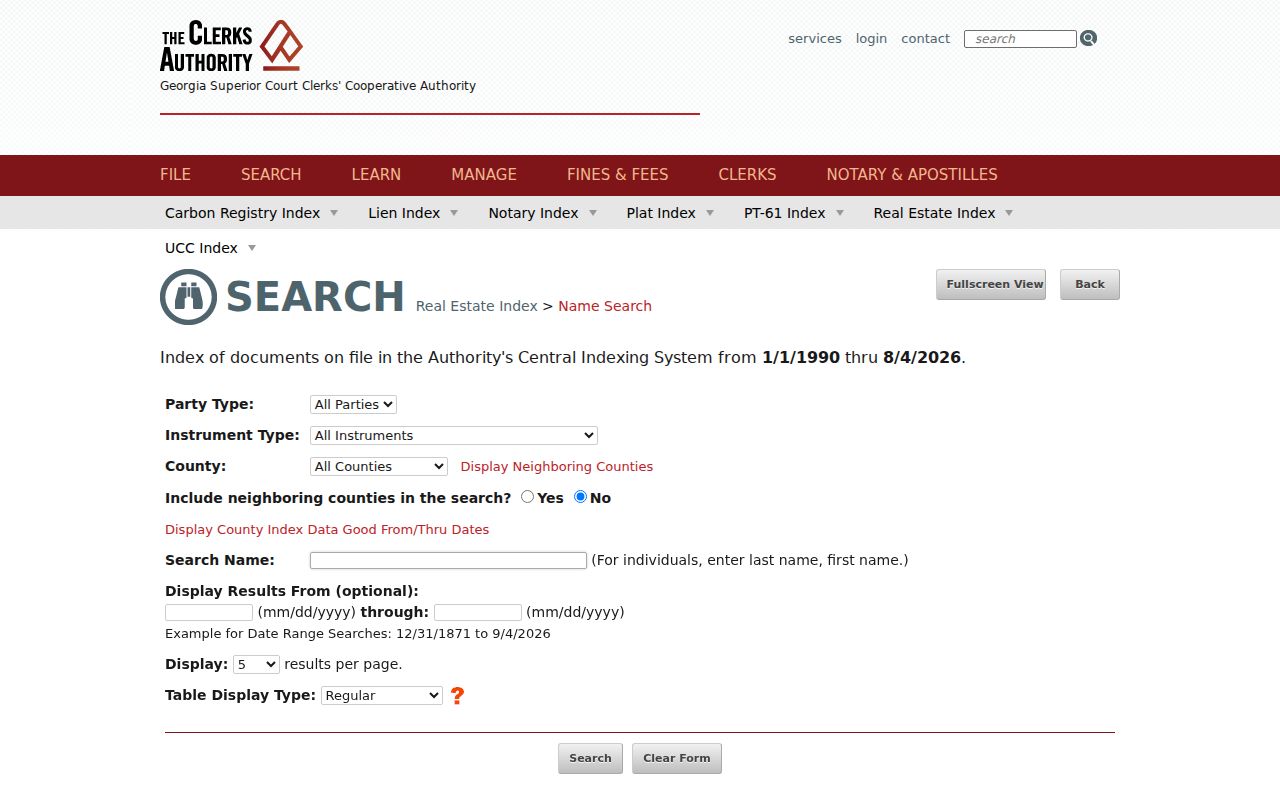
Separate party, county, date, and instrument controls let you document a search instead of running one unexplained name query. Every field you set leaves a trail.
Walk the Meriwether Grantor-Grantee Chain
Build the chain one deed at a time. Start with the newest conveyance you can trust, verify its parcel through the legal description, then follow the grantor backward. Same-name matches are not enough. Compare land lot, district, subdivision, acreage, plat references, and prior-deed citations before you accept any link in the chain.
- Find the current owner's acquiring deed with that owner in the grantee role.
- Open the image and record the grantor, instrument type, date, book/page, legal description, and cited plat or prior deed.
- Search that grantor as an earlier grantee, then compare the parcel description before accepting the link.
- Repeat until the chain predates online coverage, then continue through local deed books or archival finding aids.
- Grantor
- The party conveying the stated interest.
- Grantee
- The party receiving the stated interest.
- Chain of title
- The linked sequence of conveyances affecting the same land.
- Book/page or instrument number
- The recording reference used to retrieve the filed document.
Let the Meriwether Legal Description Carry the Chain
Addresses can change without any deed. Parcel splits create new tax identifiers. The legal description inside the deed does the hard matching, so copy it all: land lot, district, lot, block, subdivision, acreage, bearings, roads, creeks, rights-of-way, easements, reservations, and every "less and except" clause. When a deed says "more particularly shown," the cited plat becomes part of the search too.
Meriwether tax-sale filings show several identifier forms in current use, including MA06 052, GR06 078 B02, 149 022 001, and 202 002, rather than one modern parcel style. These are cross-system clues only. Older deeds may lead with land lot and district. When a newer deed or plat gives you an exact book and page, the GSCCCA book/page search takes the county, book, and page and reformats entries to its standards. It is the fastest route from citation to image.
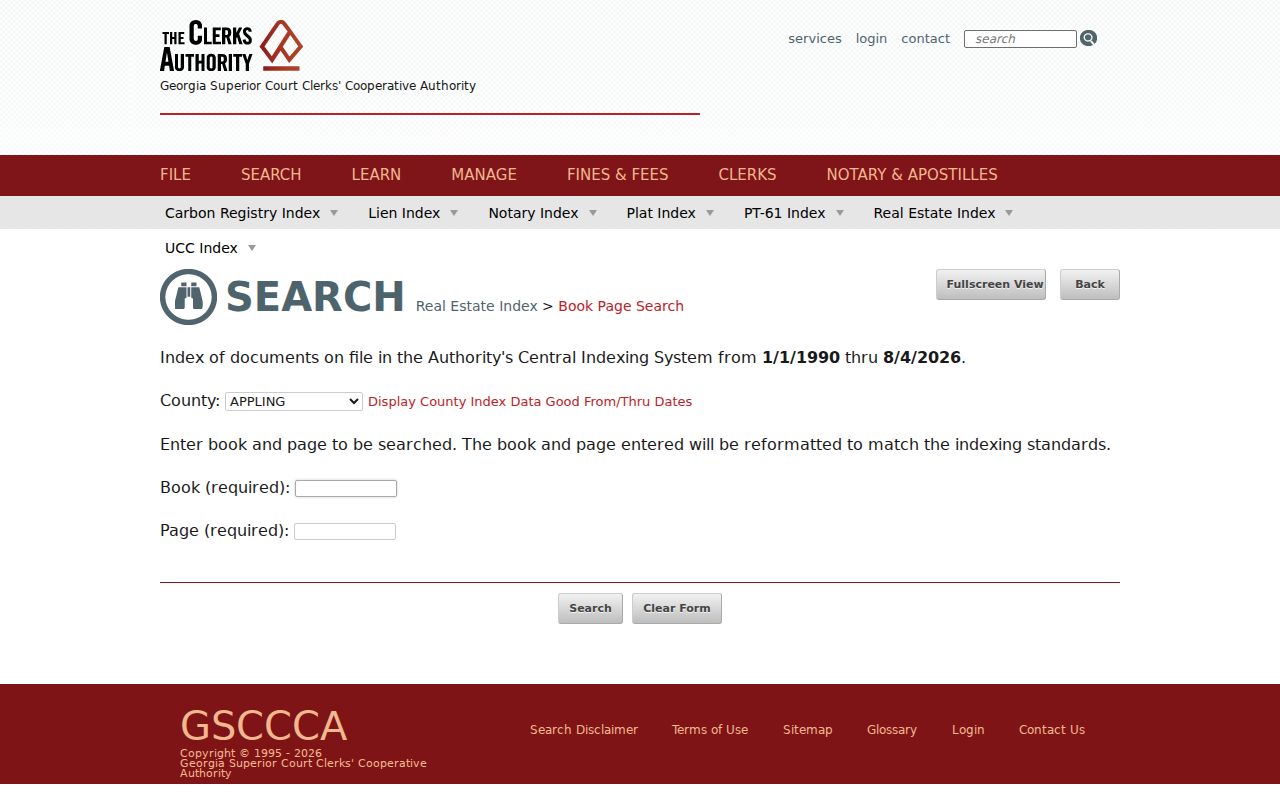
Use it when a newer deed supplies the reference.
Continue Before 1980 Through Books and Microfilm
Meriwether County dates to 1827. Plenty of its deeds predate any online index. The Georgia Archives County Records Microfilm Index inventories older deed, estate, tax, and court series on film, and the Archives advises that later records generally remain with the local custodian. FamilySearch may supply browse-only images through a free account. Certification still comes only from the Clerk.
Historic work in this county needs care. The county weathered an 1893 tornado, a 1903 courthouse replacement, and a 1976 courthouse fire followed by restoration. Archives guidance treats a disaster as a prompt for a series-by-series survival check, not proof that everything vanished. County boundaries moved over time as well, so an early Meriwether County deed can sit under a neighboring county's historical custody.
Two maps help with old references. Greenville's courthouse-centered 1828 grid clarifies a square or street mention, while the 1926 Sanborn map adds building footprints and uses as context rather than ownership evidence.
Obtain a Meriwether Deed Image or Certified Copy
GSCCCA can supply both index entries and images, depending on the county's participation and your account level. Images are sometimes missing. In that case, contact the Clerk with the party names and the recording date. Also provide a book/page or instrument number. Include the document type, the property address, and the map or parcel number. Ask for a plain copy for everyday work. Ask for certification when you need an authenticated filing.
The GSCCCA eCertification service offers a separate digital route through participating courts. You will need a universal account and a login. From there, confirm Meriwether County's participation, submit the document request. Use the authentication lookup to verify a certification code. Confirm current charges with the service or the Clerk before ordering. Meriwether deed-copy fees vary by format.
In-person and written requests still matter for off-line books or image gaps. Keep the Clerk's response on file. Know exactly what you received: an index printout, a plain image, or a certified copy.
Before ordering anything, inspect the result closely. Check the recording county, party names, execution and filing dates, instrument type, book/page, legal description, and image availability. A transfer-tax or PT-61 result can point to a sale, but it never replaces the deed itself. If the newest deed names a trust, estate, or entity, carry that exact capacity into your next search. Compare it against the assessor label rather than shortening the name.
No online hit does not mean no record exists. Ask the Clerk to check alternate spellings, index conventions, and off-line books. Also ask whether the cited page is available at the counter or by mail. Give an approximate date and the prior recording reference from the legal description. This matters most for pre-1980 links and corrected instruments. It also matters for land described by land lot rather than a modern street.
Recorded, not guaranteed. Meriwether County deed records show filed instruments, not a title opinion. Unrecorded interests, exceptions, unresolved liens, or later court orders can still affect title.
Audit Every Link in a Meriwether Deed Chain
Build the chain one row at a time. Each transfer deserves its own line: execution date, recording date, grantor, grantee, capacity, deed type, book/page or instrument number, legal description, acreage, plat citation, and prior-deed citation. A repeated surname is not enough. Compare the land lot, district, subdivision, lot, roads, and exceptions at every step.
Hunt for corrected and re-recorded instruments too. A later filing often repairs a name or legal description, so treat security deeds, assignments, modifications, and cancellations separately from straight conveyances. Tax deeds need their own file. Keep the sale notice, deed-book reference, redemption evidence, and any later quiet-title or conveyance filing together. Executor and administrator deeds work the same way. Locate the probate authority, then return to the recorded land instrument.
When the chain crosses the online cutoff, record the last digital citation before turning to a courthouse book or Archives microfilm. A book missing after the 1976 fire calls for the county-card disaster note and questions about surviving duplicate indexes or adjacent series. Report the precise gap rather than declaring the whole historical chain lost.